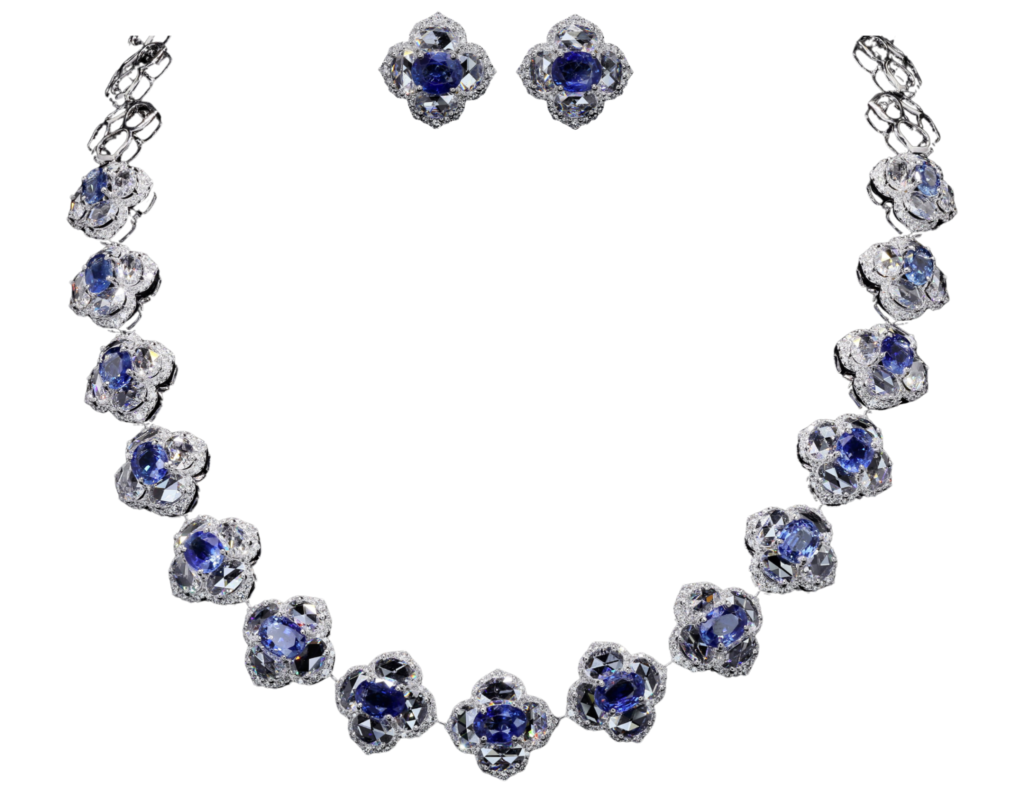
The Lucienne
Ceylon sapphires, set in mirrors of diamond
Some jewels are remembered for their scale. Others are remembered for their light. The Lucienne, a necklace and earrings in Ceylon blue sapphires and rose-cut diamonds, belongs to the second. It is a jewel of surface and colour, close at the neck and bright at the ear, made to be worn often and kept for good.
The Stone of Saturn
Sapphire and ruby are the same mineral. Both are corundum, a crystal of aluminium oxide, and among the hardest materials in nature, second only to diamond. The difference is a trace of colour. Chromium turns corundum red, and it becomes ruby. Iron and titanium turn it blue, and it becomes sapphire.
In the Navaratna, the nine gems of Indian tradition, the blue sapphire is neelam, the stone of Saturn, held as the most powerful of the nine and worn with intention. In Europe, sapphire blue became the colour of royalty and of vows, set into crowns, coronation rings and engagement rings for centuries.
The Blue of Ceylon
Few places are as closely tied to a single gem as Sri Lanka is to sapphire. The island was known in old texts as Ratna-Dweepa, the island of gems. Its sapphires have been traded for more than two thousand years, and most still come from the gem gravels around Ratnapura, whose name means “city of gems”. The Star of India, one of the most famous sapphires in the world, came from Sri Lanka.
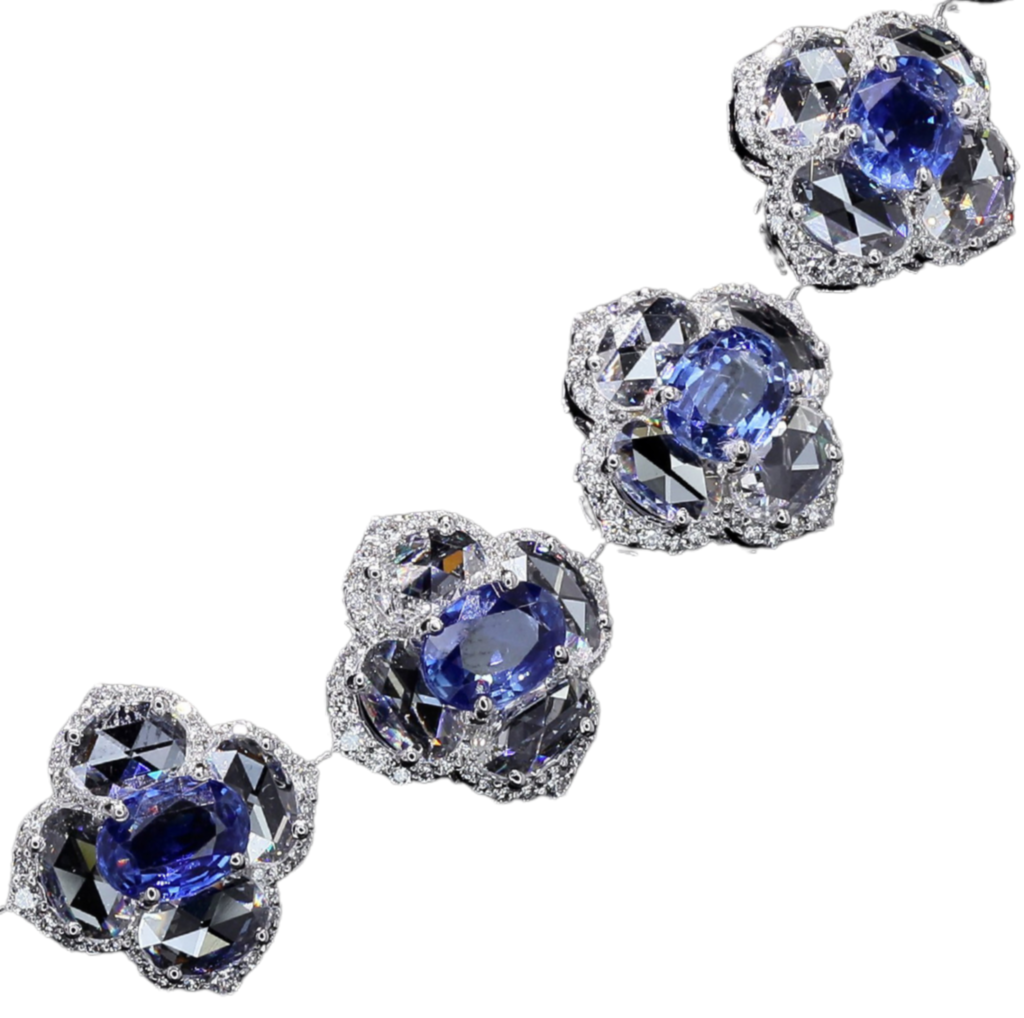
Ceylon sapphire is known above all for its brightness. The finest Ceylon stones carry a lighter, more luminous blue than most origins, one that stays lively across the whole face of the stone.
The sapphires of The Lucienne were chosen for that brightness, then assorted together and matched in tone, so a single blue runs from the clasp to the centre of the necklace. In a piece built from repetition, the matching is the art. Finding fine sapphires is the first task; finding fifteen that agree with one another is the work of the House.
The Rose-Cut
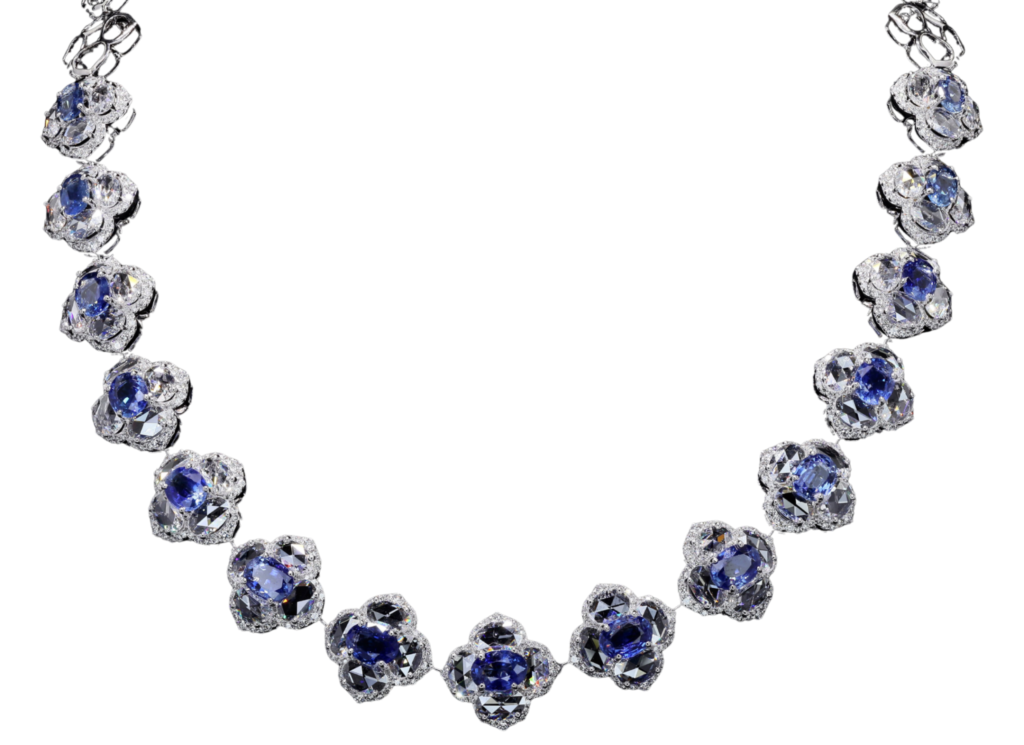
The rose-cut first appeared in the sixteenth century and remained the favoured diamond cut of the Georgian and Victorian jewellers. It is built differently from the modern brilliant. A brilliant has a deep pavilion beneath it, designed to break light into sparkle and fire. A rose-cut has a flat base, and above it rises a low dome of triangular facets, shaped, it is said, like an opening rosebud.
The result is a different kind of light. A rose-cut reflects. Light comes back from its surface in broad, glassy flashes, and the stone stays clear enough to look into, like still water.
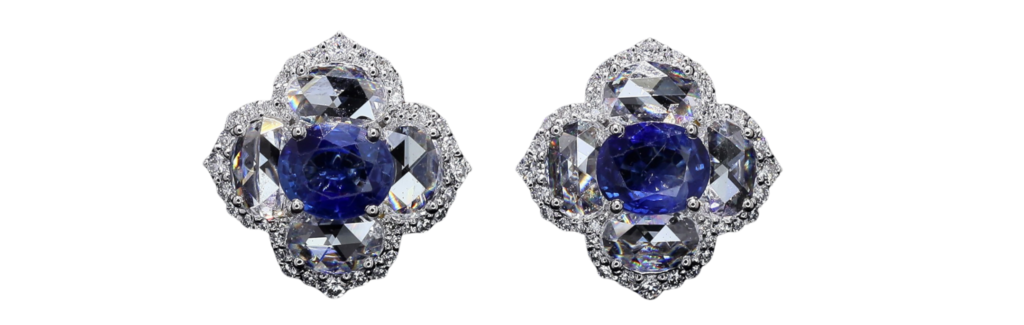
That quality is the whole of The Lucienne. Around each sapphire sit four oval rose-cut diamonds, and every one of them, across the entire necklace, is cut to the same size, the same proportion and the same height. Rose-cuts are usually cut to save weight from flat rough, so they vary from stone to stone. Matching dozens of them this precisely is what lets the four around each sapphire lie as one mirrored surface, with the sapphire rising just above them and no gap between colour and light. It is a look that belongs to the rose-cut alone.
Rosace
The Lucienne is built from a single motif, which the House calls Rosace. The name comes from the French for the rose window, the great circular windows of the Gothic cathedrals, where colour sits at the centre and light is arranged around it.
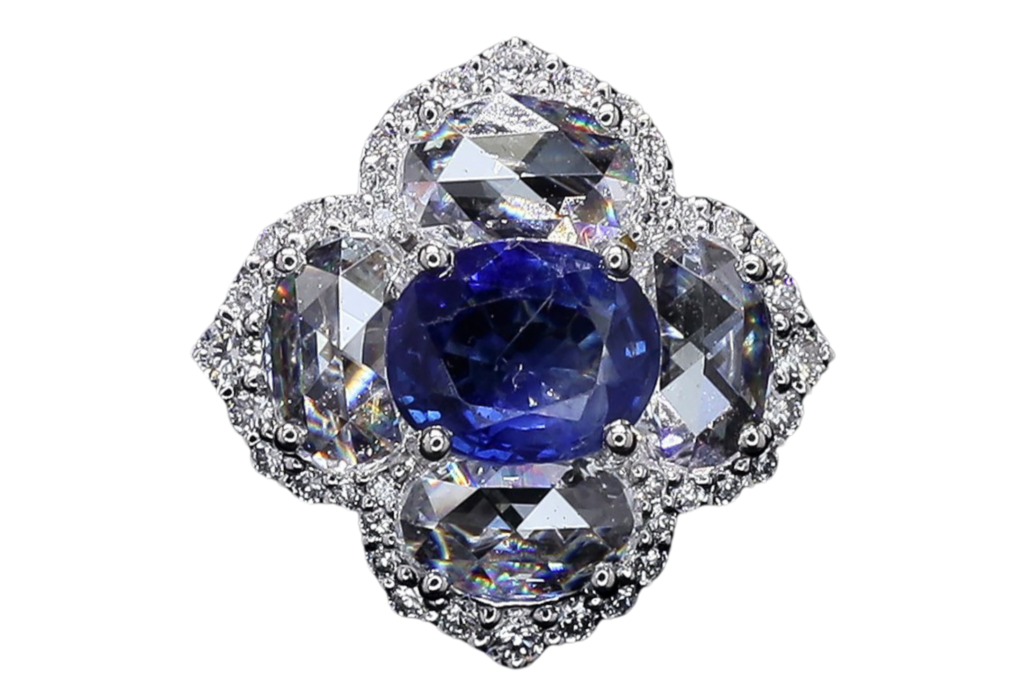
In each Rosace, a Ceylon sapphire takes the centre. Four rose-cut diamonds open around it on the cardinal points, and a border of round diamonds traces the outline, giving the motif its four-lobed edge. It is a simple figure, and it depends entirely on proportion: each stone has to be right for the figure to hold.
At the Ear
The Lucienne earrings are a single Rosace each, sized to sit within the lobe. At this distance the rose-cuts are seen at their closest: broad, shallow planes of diamond, each one a small mirror turned to the light, set level around a sapphire that rises just above them.
The Diamonds
Every diamond in The Lucienne is natural, of E–F colour and VVS–VS clarity.
The Lucienne is set in eighteen karat white gold, the standard for high jewellery.
Made to Be Worn
The Lucienne is made for every occasion: for the wedding and the anniversary, and for the ordinary evenings that become memorable because of who was there.
Sapphire blue, rose-cut light, and a line that sits close at the neck. A jewel reached for first, and kept the longest.